An AI content marketing strategy isn't about publishing more content faster.
It's about using AI to make smarter decisions — which topics to cover, which audiences to target, and which gaps your competitors haven't spotted yet.
Most marketers have adopted AI as a production tool. They use it to generate blog posts, rewrite social captions, and spin up first drafts in seconds. That's AI as a tactic. What separates the best content teams isn't how much they publish — it's how clearly they understand their audience, their competitive landscape, and the search intent behind every piece of content they create.
This guide walks through a six-step framework for building an AI-driven content strategy from scratch. You'll start with AI-built audience personas and competitive intelligence, move through meta-prompting for strategic insights, and finish with distribution, analytics, and optimization for AI search.
This article is part of our content marketing series where we cover building your first AI-assisted content workflow through advanced use cases like topic clustering, audience simulation, and content repurposing at scale.
What is an AI content marketing strategy?
An AI content marketing strategy is a framework for using artificial intelligence to guide content planning, audience research, competitive analysis, and distribution — not just to speed up writing. It sits at the intersection of content marketing (creating and sharing valuable content to attract and retain an audience) and AI (tools and models that analyze data, generate language, and surface insights at scale).
The goal is to use AI where it has the most strategic value: informing what you create, who you create it for, and where you put it — before a single word gets written. What makes an AI content marketing strategy different from simply using AI to write is that it treats AI as an analytical and research partner, not a text generator.
Strategy vs. tactics: why the distinction matters
Most articles on this topic skip this distinction entirely, so let's name it clearly: there's a real difference between using AI strategically and using it tactically.
Tactical AI use means using AI to execute a decision you've already made. You've decided to write a blog post — AI writes it. You've decided to post on LinkedIn — AI generates the caption. The decisions happen before AI enters the picture.
Strategic AI use means using AI to make better decisions. You haven't decided what to write yet — so you ask AI to analyze your competitors' content gaps, model your audience's top concerns, and identify the topics most likely to match search intent and perform. AI shapes the direction, not just the execution.
Both have value. But most content teams concentrate their effort on tactical AI use and barely touch strategic AI use — which is where the real competitive edge is.
Pro Tip: Before you use AI to produce any piece of content, ask yourself: did AI help me decide why this piece is worth creating? If the answer is no, you're using AI tactically, not strategically.
The AI-first content mindset explained
An AI-first content mindset means making AI-assisted research and analysis the first step in your content process, not the last.
In a traditional workflow, a content strategist might spend days on audience research, competitive analysis, and keyword research before writing a word. In an AI-first workflow, you compress that research phase from days to hours — and you get more insight, not less, because AI can process and synthesize information at a scale no human researcher can match.
The shift isn't about replacing human judgment. It's about making sure that judgment is informed by better data, faster. You still make the calls. AI just makes sure you're making them with a full picture.
Why most marketers are using AI wrong
Most AI content marketing advice focuses on output. How to write faster. How to generate more posts. How to scale a content calendar without adding headcount.
That's not wrong — those things have real value. But they're also why so much AI-assisted content sounds exactly the same.
The content output trap
The content output trap is what happens when AI use optimizes for volume — more posts, more captions, more emails — without a strategy to match.
Content that's fast to produce but misaligned with your audience's real needs gets ignored. Content that covers topics your competitors have already addressed thoroughly won't rank or resonate. Content with no clear point of view disappears into the wall of generic AI-generated text that now floods every niche.
The output trap is seductive because it's measurable. You can count posts. You can hit a publishing frequency target. What you can't easily measure — until you check your analytics — is whether any of it is working.
What AI-driven strategy actually looks like
An AI-driven content strategy looks less like a content factory and more like a research department.
You use AI to build a detailed picture of your audience before you plan any topics. You use it to map the competitive landscape and find the gaps nobody's filling. You use meta-prompting to extract strategic insights — the kind that would take a senior strategist hours to produce manually. Then, and only then, you use AI to help produce the content itself.
The result is content with a reason to exist: it speaks to a specific audience, covers an angle competitors have missed, and is built on insight rather than keywords alone.
Common Mistake: Jumping straight to content creation without running audience and competitive research first. The best AI-assisted content comes from teams that front-load the research phase, not the production phase.
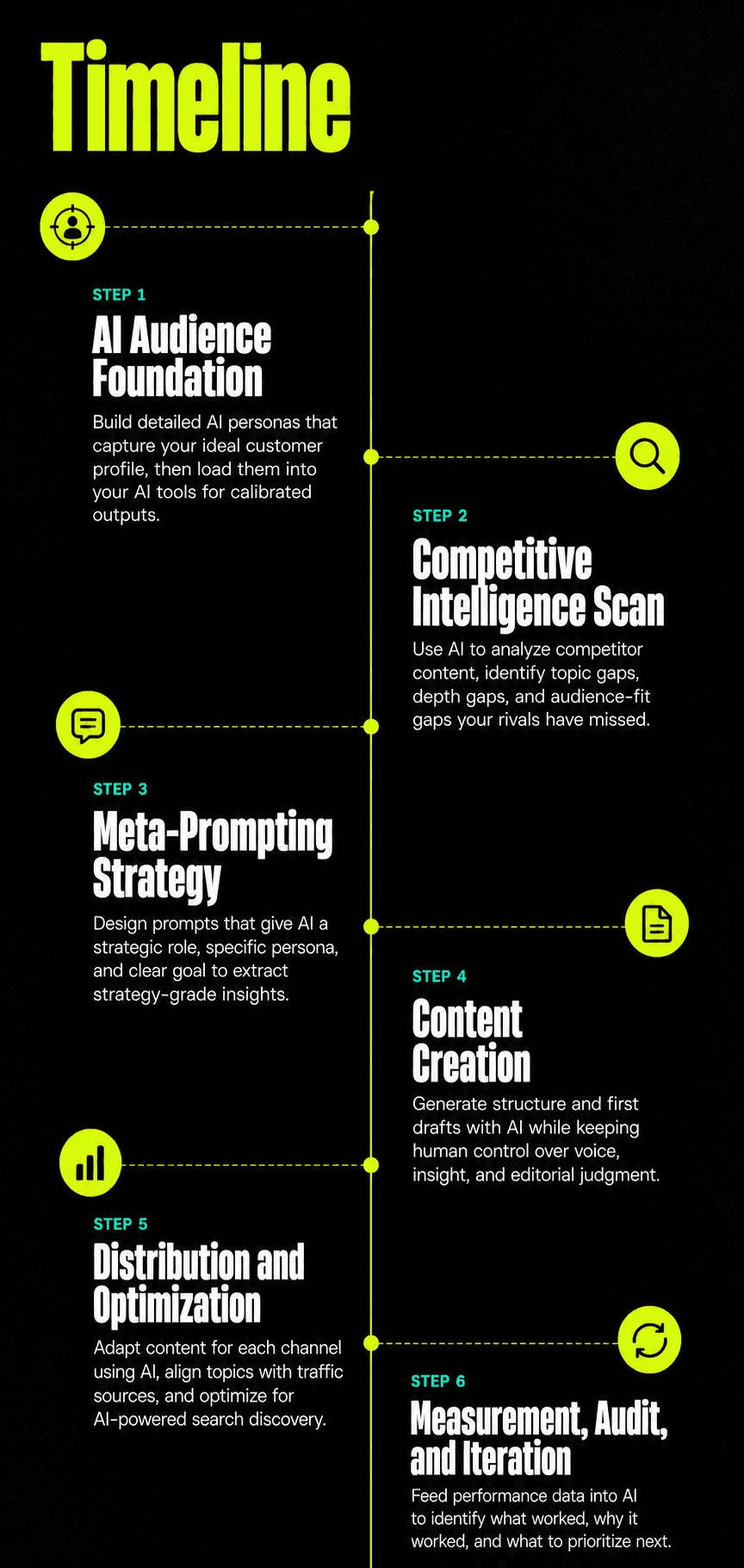
Step 1 — Build your audience foundation with AI personas
Every strong content strategy starts with a clear picture of who you're writing for. Before AI can help you strategically, you need to train it on your audience. A vague prompt with no audience context produces average, generic output. A prompt backed by a detailed audience persona produces something much closer to what your readers actually need.
How to generate a draft ICP with AI prompting
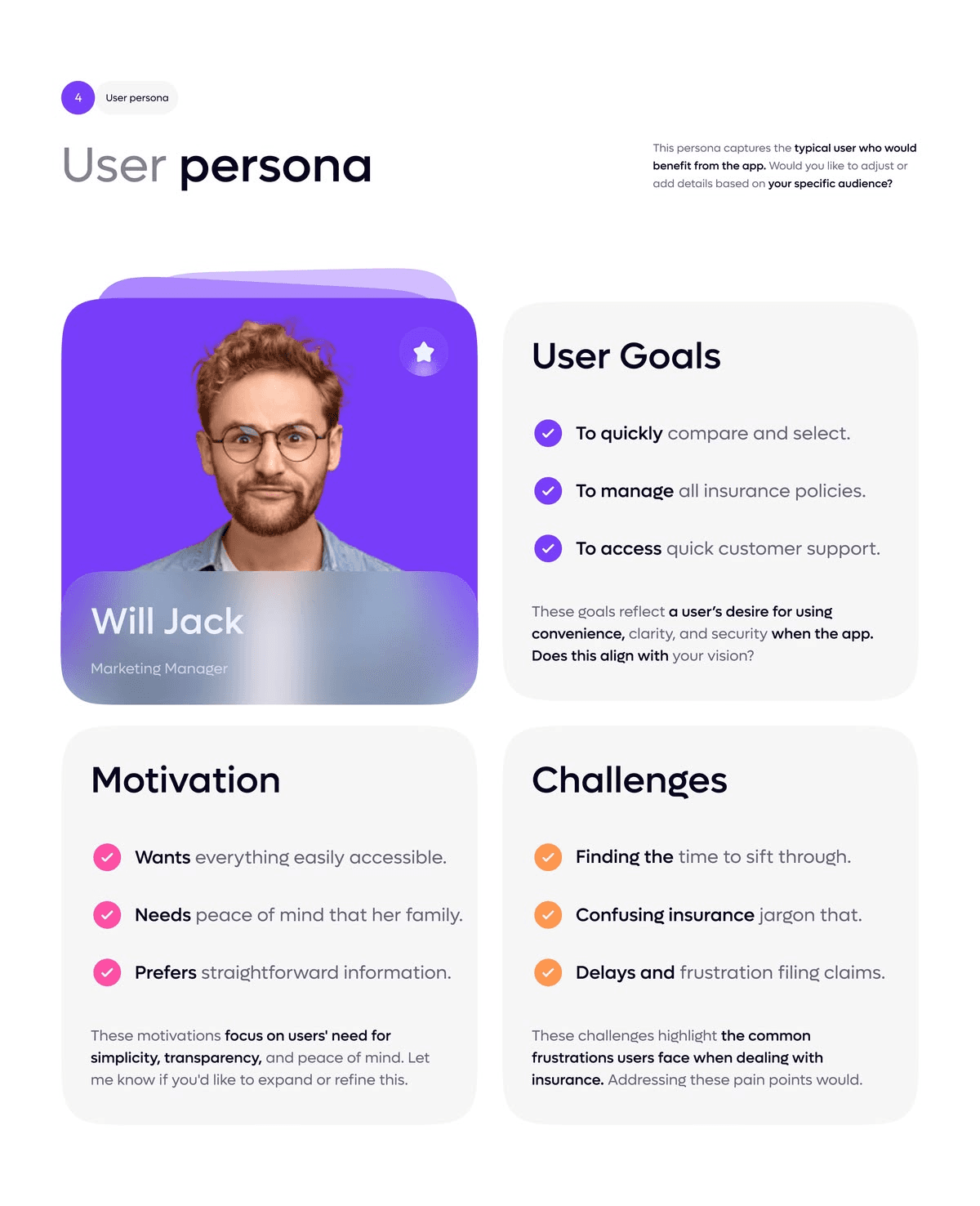
If you don't have a documented ideal customer profile (ICP) or audience persona yet, AI can help you build one quickly.
Give AI enough context to produce something accurate, then spend time reviewing and tightening it. Here's a prompt template that produces strong draft personas:
Create a detailed persona for a [job title] working in [industry/company size/geography] who is responsible for [roles/skills/responsibilities]. This person is facing challenges with [specific challenge] and is actively seeking [product/service/information] to address them.
What are their hopes and goals? What are their fears and concerns?
What are the emotional triggers that would prompt them to take action?
What criteria do they use when evaluating solutions?
The draft won't be perfect — but it will surface insights that stakeholder interviews often miss. Review it critically, edit it based on what you know about real customers, and add nuances that only come from direct experience with your audience.
Once you've refined it, save it as a PDF or load it into a custom GPT, Claude Project, or Gemini Gem. Every AI interaction from that point forward will be better calibrated to your actual audience.
Turning your AI into a synthetic audience member
A synthetic audience member is an AI instance loaded with your persona, used to pressure-test content ideas, topic angles, and messaging before you invest time building anything.
What do they search for before they find you? What questions keep them up at night? What would make them share a piece of content with a colleague? What objections do they have about your category?
This technique isn't a replacement for talking to actual customers, but it's a strong supplement when you need fast directional insight on search intent, content relevance, or audience fit.
Content-audience fit: the test every topic should pass
Content-audience fit is the test that asks: does this topic matter to my specific audience, covered in the way I plan to cover it?
AI makes it easier to apply this test at scale — describe a proposed topic to your persona-loaded AI and ask directly: "Would this topic be useful to this audience? What angle would make it most relevant? What would they be hoping to get out of reading it?"
If the answers reveal a weak connection between the topic and your audience's real concerns, that's a signal to rethink the angle before you invest time writing.
Step 2 — Run competitive intelligence with AI
Most content teams do competitive research manually: browse competitor blogs, note what topics they cover, try to spot gaps. It works, but it's slow and incomplete. AI lets you run the same analysis in a fraction of the time — and at a depth that manual review can't match.
The competitive intelligence scanner prompt

The competitive intelligence scanner is a meta-prompt that turns your AI into a content gap-finder. Here's a template you can adapt:
You are a senior content strategist. I'm going to give you: 1. A description of my target audience: [paste persona or ICP] 2. Three to five competitor articles on [topic]: [paste URLs or content] 3. My top-performing articles on this topic: [paste URLs or content, if available]
Your task: Identify the topics, questions, and content angles that my competitors are consistently covering — and the topics, questions, and angles they are missing entirely. Prioritize gaps that would be most valuable to my target audience. Output a ranked list of the top 10 content opportunities, with a 2-sentence explanation of why each matters.
Run this with your actual competitor content and you'll have a prioritized content gap report in under 15 minutes. What would have taken a content strategist half a day gets done before your next coffee.
How to find content gaps your competitors are missing
Content gaps aren't just missing topics — they're missing angles, missing depth, and missing audience-specific relevance.
Your competitors might cover "AI content strategy" broadly but never address it for B2B SaaS marketing teams specifically. They might explain what AI tools do but never explain how to prompt them for strategic outputs. They might list tactics but never explain the framework that ties them together.
When you run your competitive intelligence scan, look for 3 types of gaps:
Topic gaps — subjects your audience cares about that competitors haven't covered at all
Depth gaps — topics competitors cover superficially that deserve a thorough, dedicated treatment
Audience-fit gaps — topics covered generically that could be far more relevant with your specific audience's context applied
The third type is the most overlooked — and often the most valuable for building topical authority.
Learn to conduct AI-powered intent gap analysis with our new guide.
Using AI to analyze SERP patterns at scale
AI can analyze the SERP patterns of top-ranking content for your target keywords — identifying recurring H2 structures, FAQ patterns, and entity clusters that signal topical authority to semantic search engines.
Feed 5–10 top-ranking articles into an LLM and ask it to map those structural patterns. You're asking AI to do what a senior SEO would do manually in hours — identifying what search engines associate with authority on this topic.
The goal isn't to copy those patterns. It's to include the signals that matter while going further and covering what nobody else has.
Step 3 — Use meta-prompting to build strategic content insights

Meta-prompting is the most powerful and least-used technique in AI content strategy. It's also what separates content teams that get average AI outputs from those that get real strategic value from it.
What is meta-prompting?
Meta-prompting is the practice of designing prompts that give AI a strategic role — a specific persona, a methodology, and a clear goal — rather than simply asking it to produce output. Instead of "write a blog post about AI content strategy," a meta-prompt might say: "Act as a senior content strategist who has analyzed our target audience and reviewed our 3 main competitors. Identify the 5 content angles we're most likely to win on — topics our competitors haven't covered well, that our audience genuinely needs, and that align with our content mission."
The output from a meta-prompt is strategy-grade. The output from a basic prompt is content-grade.
A basic prompt asks AI to produce. A meta-prompt asks AI to think, within a specific framework, toward a specific strategic goal.
Click here to learn more about prompt engineering tailored for content teams.
5 meta-prompts every content strategist should know
These 5 prompts cover the core research and planning tasks in an AI-driven content strategy. Save them, share them with your team, and reuse them:
1. The Competitive Intelligence Scanner
Act as a senior content strategist. Analyze the following competitor articles [paste content] and my own top content [paste content] for an audience of [describe audience]. Identify the 10 highest-value content gaps — topics, angles, and questions competitors haven't addressed well that my audience would find genuinely useful. Rank them by potential impact.
2. The Industry Report Generator
Act as a research analyst covering [industry]. Based on the following sources [paste sources or describe recent trends], generate a structured overview of the most important trends, data points, and emerging topics in [industry] that a content marketer should be addressing in the next 6 months. Include: what's changing, why it matters, and what questions it's generating in the market.
3. The AI Audience Persona Builder
Create a detailed persona for a [job title] in [industry/company size]. Include: their primary responsibilities, biggest day-to-day challenges, what they search for when they need help, what they fear getting wrong, what content formats they prefer, and what would make them trust a new information source. Make it specific enough to use as a content planning guide.
4. The Content Gap Analyzer
I'm going to give you my content inventory [paste titles or topics] and my target audience's top questions [paste or describe]. Identify: (a) which audience questions I haven't answered at all, (b) which I've answered superficially, and (c) which I've answered well. Prioritize the first two categories by audience value and competitive opportunity.
5. The Channel-Topic Alignment Prompt
I'm going to give you a GA4 export showing how my content performs across traffic sources [paste or describe data]. Based on this data, suggest 10 new content topics aligned with the channels where they're most likely to perform. For each, recommend a primary distribution channel and one specific promotion tactic.
Building a reusable prompt library for your team
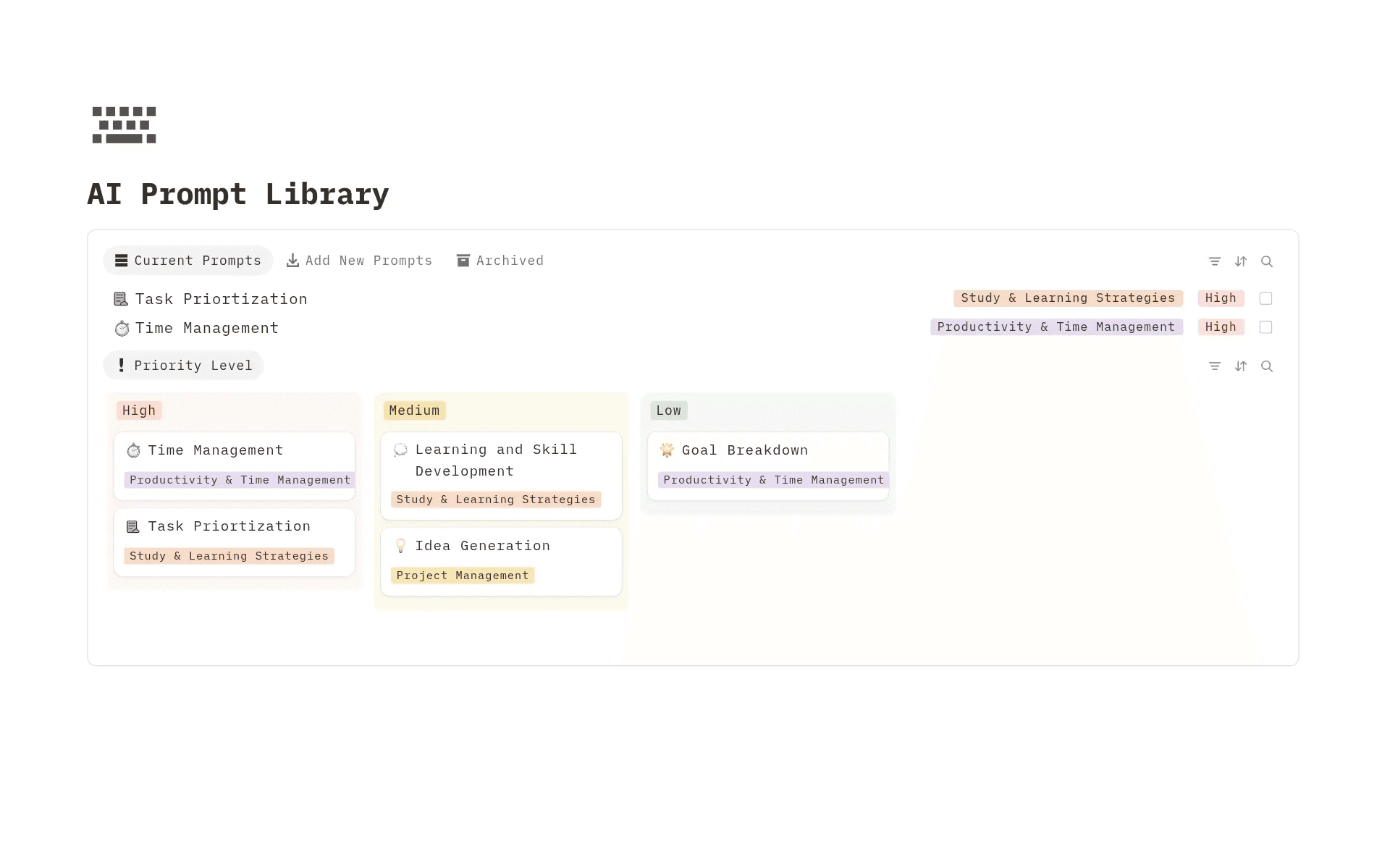
A prompt library is a shared collection of your best-performing prompts, organized by use case and reused across your team.
Build one in a shared Google Doc, a Notion database, or directly inside the AI tool itself — custom GPTs, Claude Projects, and Gemini Gems all let you save context and instructions that persist across conversations.
When a new content strategist joins your team, handing them a prompt library gets them producing at a senior level from day one. It encodes your best strategic thinking into a reusable system that compounds in value over time.
Pro Tip: Tag each prompt with the use case, the AI tool it works best in, and the last date it was tested. Prompts degrade as models update, so treat your library like a living document.
Step 4 — Create and automate content without losing your voice
Once your strategy is grounded in audience insight and competitive intelligence, AI can genuinely speed up content creation. The goal isn't to automate away the human element — it's to automate the parts that don't require it, so your creative energy goes where it matters.
AI content creation vs. AI content strategy
There's a clear line between using AI for strategy (Steps 1–3) and using AI for creation. Knowing where that line sits helps you allocate your time correctly.
AI is strong at generating structure, producing first drafts, suggesting headlines, and adapting content for different formats, such as social posts, email newsletters, and video scripts. It's poor at developing genuine points of view, drawing on direct experience, expressing brand personality, and making the editorial judgments that separate good content from forgettable content.
The best AI-assisted content workflow uses AI for the scaffolding — structure, research synthesis, first-draft prose — and keeps human attention for the judgment calls: the angle, the tone, the original insight, the story that makes a piece worth reading.
How to build a brand voice library for AI
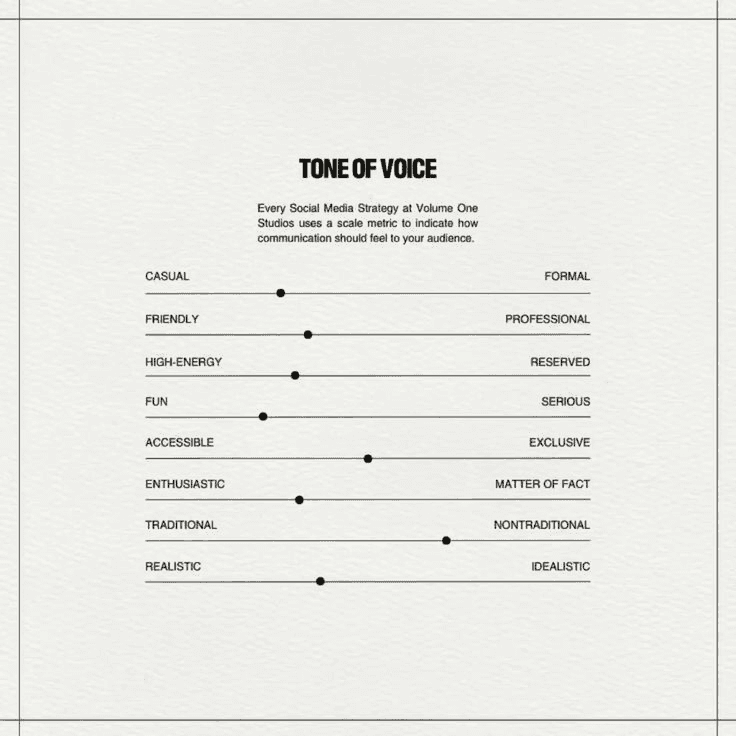
AI defaults to a generic, competent-but-bland voice unless you train it on yours. A brand voice library fixes this.
At minimum, a brand voice library includes 4 components:
3–5 examples of your best-performing content — pieces that best represent your voice, tone, and style
A voice description — not just adjectives ("professional, warm, direct") but specific guidance: how you handle jargon, whether you use humor and when, how formal your CTAs are, what you never say
A negative example — a piece that shows what you want to avoid (often more instructive than positive examples alone)
Audience-specific tone notes — if your tone shifts across channels or audience segments, document that explicitly
Load this library into your AI tool's context at the start of any content creation session. The difference in output quality is real.
Automating first drafts while keeping human creative control
The most practical AI content creation workflow runs in 5 steps:
Brief with intent — give AI the topic, the audience, the key entities to cover, and the angle you want to take. The brief is a human decision, informed by the strategic work in Steps 1–3.
Generate the structure — ask AI to produce an outline first. Review it before writing begins. This is your chance to catch strategic misalignment early.
Draft section by section — generate body sections individually rather than asking for a full article at once. You maintain more control, catch errors sooner, and can adjust direction mid-draft.
Edit for voice and insight — treat the AI draft as a first draft, not a final one. Add your perspective, your experience, your original examples. This is what turns AI-assisted content into content that feels like it came from a real person with real expertise.
Final human review — fact-check, tighten the structure, make sure the intro earns the reader's attention and the conclusion gives them something to take away.
Writing for SEO doesn't have to be hard. Learn how to use AI to generate optimized blog posts in our new guide.
Step 5 — Distribute and optimize across channels
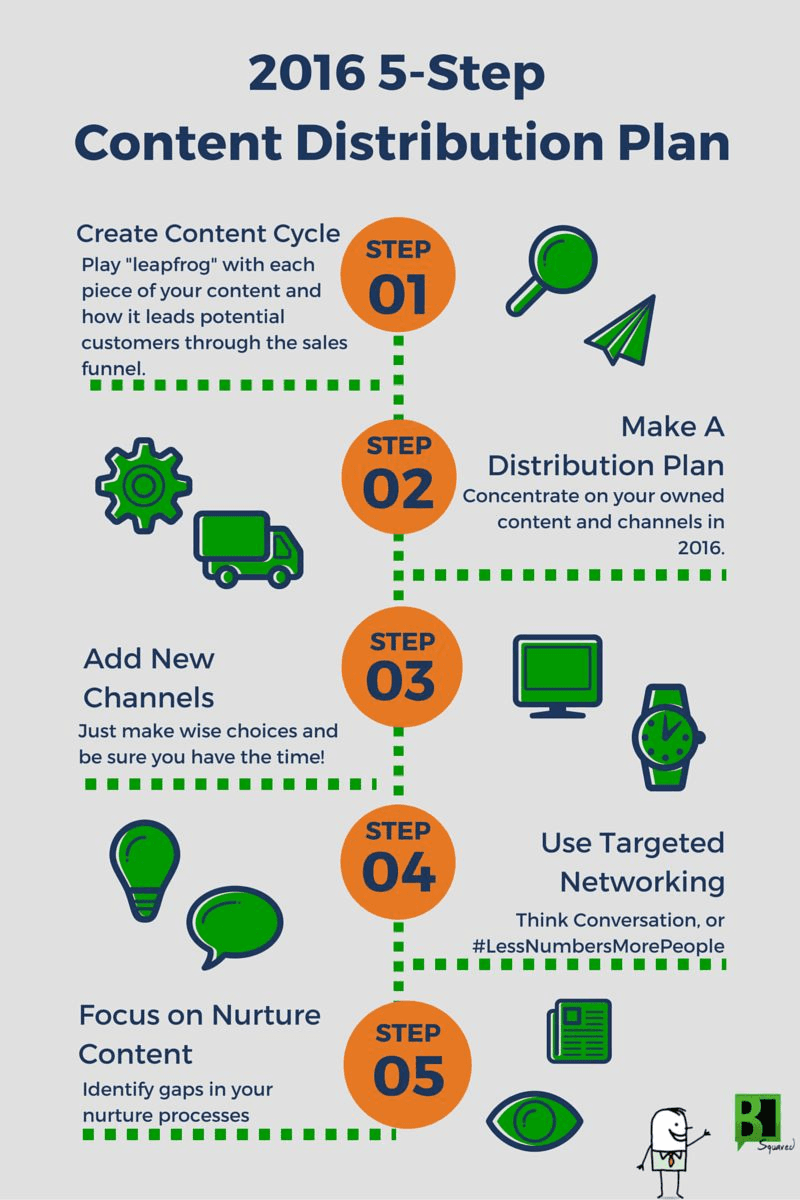
Publishing is not the finish line. A piece of content nobody sees is no different from one that was never written. Distribution is where strategy meets reality — and AI can help you do it more intelligently than manual approaches allow.
Multi-channel AI publishing: matching content to context
Different channels have different audiences, different formats, and different norms. A 2,000-word blog post doesn't work as a LinkedIn post. Twitter requires a completely different approach than an email newsletter.
AI can help you adapt a single piece of core content for every channel it needs to reach — not by duplicating it, but by genuinely reformatting it for each context. Give your AI the core content, the persona for that channel's audience, and the format constraints, then ask it to produce channel-specific versions.
Treat adaptation as a strategic task, not a mechanical one. A LinkedIn post adapted from a long-form article shouldn't just excerpt a paragraph — it should identify the most conversation-worthy insight and build a native LinkedIn format around it.
Turn one piece of content into ten with our step-by-step repurposing guide.
Using GA4 data and AI to align topics with traffic sources
Here's a technique most content teams don't use but should: feed your GA4 performance data into an AI and ask it to identify which topics perform best in which channels — then use that analysis to inform your next round of content planning.
The workflow is simple. Export your Pages and Screens report from GA4, filtered to blog content and excluding direct traffic. Include page title, session source, engagement rate, and sessions. Clean up the file (remove low-traffic rows and anything irrelevant) and upload it to your AI tool with this prompt:
You are a content strategist and analytics expert. I'm giving you a GA4 report showing how our blog content performs across traffic sources. Using this data, suggest 10 new content topics that align with the channels where they're most likely to perform. For each topic, recommend one specific promotion tactic for the primary channel.
The result is a data-informed content plan, not a brainstormed list. Topics are matched to the channels where your historical data says they'll work — which improves the ROI of both content creation and distribution.
Generative Engine Optimization (GEO): optimizing for AI search
Generative Engine Optimization (GEO) is the practice of structuring content so it gets surfaced in AI-generated answers — in Google AI Overviews, ChatGPT search, Perplexity, and other AI-powered discovery tools. As more of your audience starts research by asking an AI rather than typing into a search box, being absent from those AI-generated responses means being invisible to a growing share of potential readers.
GEO is an extension of SEO, not a replacement for it. It draws on the same principles of semantic search — entity coverage, topical authority, structured data — but applies them specifically to how LLMs retrieve and cite content. Also called LLMO (Large Language Model Optimization) in some contexts, GEO is rapidly becoming a standard part of content strategy.
5 signals make content more likely to appear in AI-generated responses:
Direct declarative definitions — AI systems favor content that answers a question clearly in the first 1–2 sentences of a section. "Generative Engine Optimization is the practice of..." beats a paragraph that builds to a definition at the end.
Full entity coverage — cover the core entities associated with your topic explicitly. Don't assume AI can infer what you mean; name the concepts, tools, techniques, and relationships directly.
Structured FAQs with FAQPage schema — FAQ sections get cited in AI-generated responses at a disproportionately high rate. Mark them up with schema so AI systems can extract and attribute them cleanly.
Cited, authoritative sources — content that references credible external sources is more likely to be treated as reliable by AI systems.
Specific, concrete answers — vague or hedged answers rarely get cited. Use numbers and timeframes where accurate. State positions clearly.
Pro Tip: Run your finished article through an AI search query on your topic. If your content doesn't appear in the response, look at what does and note the structural differences. Usually it comes down to definition clarity, FAQ coverage, or missing entities.
Step 6 — Measure, audit, and iterate with AI insights
Step 6 closes the loop — use performance data to sharpen your next planning cycle. AI speeds this process up significantly, turning what used to be a quarterly manual review into an ongoing process.
Content performance analysis beyond vanity metrics
Traffic is a starting point, not an endpoint. The metrics that actually tell you whether your content strategy is working are engagement rate, scroll depth, time on page, and — most importantly — assisted conversions: pieces of content that weren't the last touch before a conversion but contributed meaningfully along the way.
Feed your performance data into AI with a question that goes beyond "what performed well" — ask it why. What do top-performing pieces have in common? Which topics drove the most engagement from your target audience specifically? Which channel-topic combinations produced the highest-quality traffic, not just the highest volume?
Those answers are what make your next content plan smarter than your last.
How to use AI to run a content audit
A content audit is a systematic review of your existing content — identifying what's performing, what's declining, and what should be updated, repurposed, or cut. Manually, it's time-consuming. With AI, you can compress it significantly.
Export your content inventory (URLs, titles, publish dates, traffic, engagement) and feed it into an AI with this prompt:
I'm giving you a content inventory for our blog. Analyze it and organize it into four tiers: (1) high-performing — keep and internally link to; (2) underperforming but salvageable — flag for refresh or expansion; (3) outdated — flag for update with current information; (4) low-value — flag for consolidation or removal. For each piece flagged for action, suggest the specific action and why.
The resulting audit gives you a prioritized action list that would have taken days to build manually. You still make the final calls — AI doesn't know your business strategy — but the analysis work is done.
Predictive content planning: what to publish next
Predictive content planning means feeding your audit results, top-performing topics, persona, and content gaps into AI to generate a ranked list of your next 10 content topics.
Instead of brainstorming from scratch, you're making evidence-informed decisions about where to invest your content creation effort. Each cycle of content → measure → audit → plan → content produces better results than the one before, because each cycle draws on more data about what actually works for your specific audience.
Learn exactly how your content is performing with this step-by-step measurement guide.
AI content marketing strategy tools
The right AI tools for content strategy depend on what you're trying to accomplish. The key distinction: tools for strategy (research, analysis, planning) vs. tools for creation (writing, editing, formatting).
Best AI tools for strategy (vs. creation)
For overall content creation:
DFIRST AI
DFIRST lets you build smart content workflows, making your campaigns faster and always on-brand.
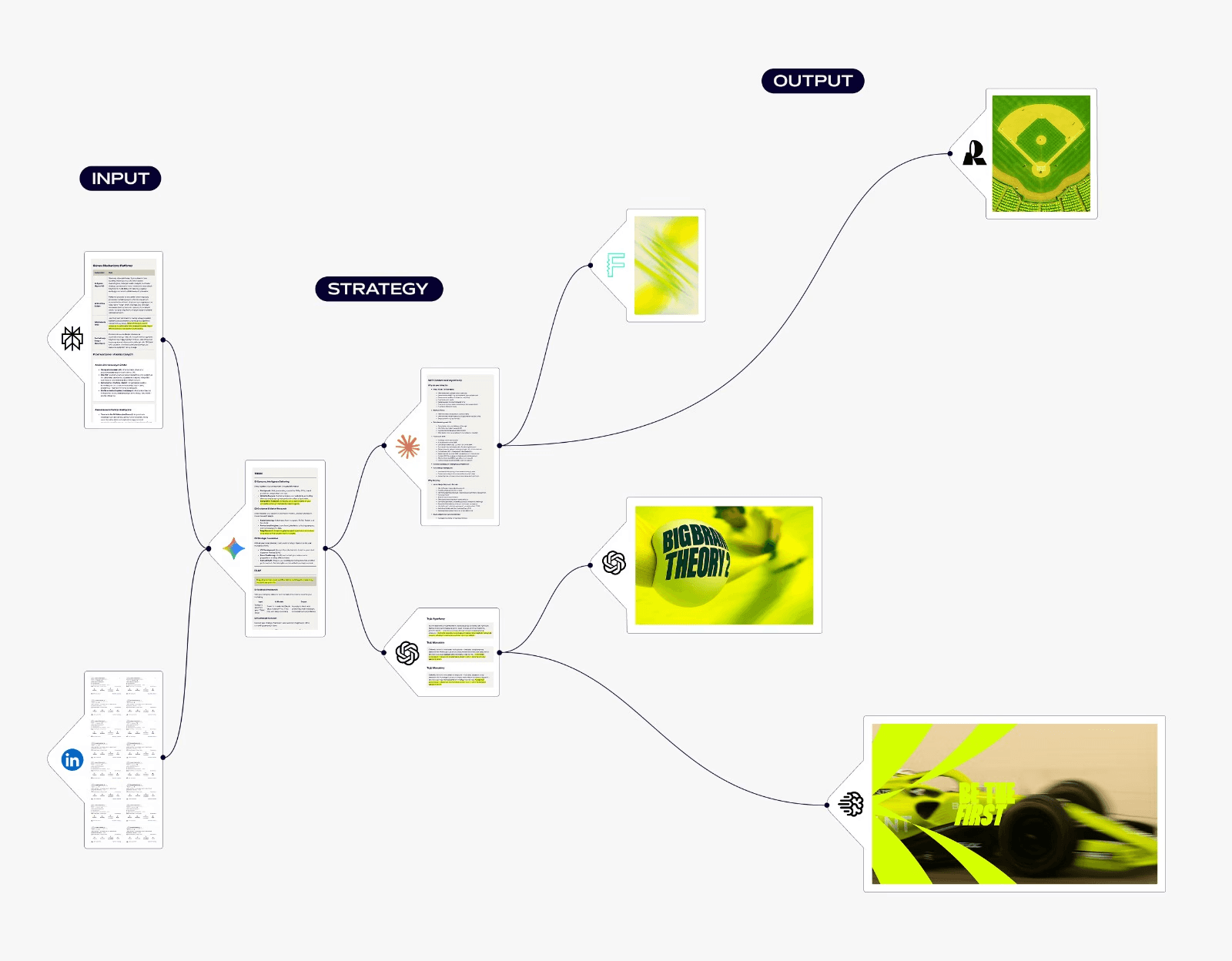
Key Features You’ll Love
💚 Visual Workflow Builder: Design your own marketing workflows with an intuitive interface
💚 Data Room: Upload and analyze your business information for AI-powered insights
💚 Advanced Research Tools: Connect with real-time market intelligence
💚 Content Generation: Craft high-quality copy using multiple LLMs (Claude, GPT, Gemini & more)
💚 Visual Creation: Design graphics with DALL-E 3, Stable Diffusion, and other image tools
💚 Video Generation: Produce high quality videos with VEO 3, Sora, and other AI video generation tools
💚 Workflow Automation: Link sections for smooth data flow throughout your campaigns
Why not take a look?
Generate your first flow for free – no credit card required.
For research and analysis:
Perplexity — strong for real-time research with sourced citations; good for competitive overviews and trend research
Claude — well-suited for long-context analysis: feed it full competitor articles, persona documents, and GA4 reports and ask for strategic synthesis
ChatGPT — flexible and widely supported; the strongest ecosystem for custom GPTs and prompt-based workflows
For creation:
Major AI writing tools (DFIRST, ChatGPT, Claude, Gemini) handle first drafts well when given a strong brief and brand voice context
Purpose-built content marketing platforms (like StoryChief) integrate AI writing with content calendar management, distribution, and performance analytics in a single workflow
For SEO and content gap analysis:
AI-native SEO tools that connect to Google Search Console and surface keyword opportunities in context are the most practical option for teams that want strategy and production in one place
How to choose the right LLM for your workflow
No single LLM is best at everything. If [the task] is long-context analysis — reading full articles, documents, or data reports — then Claude is the strongest choice given its large context window. If [the task] is flexible prompt workflows and custom tooling, then ChatGPT's custom GPT ecosystem is the most mature and widely integrated option. If [the task] is real-time research with web access, then Perplexity is purpose-built for it, though ChatGPT and Claude also offer web search. If [the task] is Google Workspace integration, then Gemini connects natively with Google Docs, Drive, and Search Console.
Most effective content teams use 2–3 LLMs for different tasks, and the decision of which to use when becomes second nature within a few weeks.
AI content marketing strategy FAQs
What is an AI content marketing strategy?
An AI content marketing strategy is a framework for using artificial intelligence to guide content decisions — not just content production. It includes using AI for audience research, competitive analysis, content gap identification, and channel alignment. The goal is to use AI where it has the most strategic value, rather than treating it purely as a writing tool.
How is using AI for content strategy different from using it to write content?
Using AI to write content is tactical — it speeds up production. Using AI for content strategy is about making better decisions: which topics to cover, which audiences to target, which competitors to outflank. Strategic AI use happens before the writing starts. Tactical AI use handles the writing itself.
What is meta-prompting and why does it matter for content strategy?
Meta-prompting is the practice of designing prompts that give AI a strategic role — a persona, a methodology, a goal — rather than simply asking it to produce output. Instead of "write a blog post about X," a meta-prompt might say "act as a senior content strategist, analyze these 3 competitor articles, and identify the 5 angles none of them have covered." The output is strategy-grade, not just content-grade.
What AI tools are best for content marketing strategy?
It depends on the task. For research and competitive analysis, Perplexity and Claude perform well. For persona building and prompt-based strategy work, ChatGPT and Claude are strong. The key is matching the tool to the task, not defaulting to one tool for everything.
How do I use AI to find content gaps?
The most efficient approach is the competitive intelligence scanner: feed 3–5 competitor articles plus your own top-performing content into an LLM, along with a description of your target audience. Ask the AI to identify topics, questions, and angles that competitors haven't addressed — especially ones your audience would value. You'll have a prioritized content gap report in under 15 minutes.
What is Generative Engine Optimization (GEO)?
Generative Engine Optimization (GEO) is the practice of structuring content so it gets surfaced in AI-generated answers — from Google AI Overviews, ChatGPT search, and Perplexity. Key signals include direct declarative definitions, structured FAQs with schema markup, full entity coverage, and cited authoritative sources. As AI-powered search grows, GEO is becoming as important as traditional SEO for content visibility.
Can AI replace a human content strategist?
Not in any meaningful way, at least not yet. AI can dramatically speed up research, analysis, and insight generation. But it lacks the judgment to interpret those insights in the context of brand positioning, audience relationships, and business objectives. The best results come from AI handling the analytical and generative work while humans apply strategic direction, creative judgment, and editorial oversight.
How do I measure the ROI of an AI content marketing strategy?
Track the same KPIs you'd use for any content strategy: organic traffic, engagement rate, time on page, and assisted conversions. Also measure efficiency gains: hours saved on research, time from brief to publish, and content output per team member. The ROI shows up in both outputs (better-performing content) and inputs (faster, cheaper content development).
It's a wrap
An AI content marketing strategy is a commitment to making better decisions, not faster content. The 6-step framework here moves from audience foundation to competitive intelligence to meta-prompting to creation, distribution, and measurement. Each step builds on the last.
The shift from AI-as-tactic to AI-as-strategy is the one that compounds. Start with Step 1 — build your audience persona and train your AI on it — and let the rest follow. You don't need to implement all 6 steps at once. You just need to start with strategy.