Content quality doesn't suffer because your writers lack talent. It suffers because everyone on your team talks to AI differently.
One writer asks for "a punchy intro." Another asks for "an engaging opening paragraph for a B2B audience in a direct, conversational tone." One of those prompts gets a generic two-liner. The other gets something publishable. That gap — between a vague instruction and a precise one — is exactly what prompt engineering closes.
Prompt engineering for content teams isn't about becoming a developer or memorising technical syntax. It's about learning to communicate with AI models the way you'd brief a skilled freelancer: with context, constraints, and clear expectations. When your whole team does this consistently, your content becomes faster, more consistent, and on-brand at scale.
Here's what we'll cover:
What prompt engineering means for content work
Why it matters beyond "getting better at AI"
How to structure prompts that work across content types
The 5 core techniques every content team should know
How to scale prompt engineering as a team practice
Let's get into it.
This article is part of our content marketing series where we cover building your first AI-assisted content workflow through advanced use cases like topic clustering, audience simulation, and content repurposing at scale.
What is prompt engineering for content teams?
Prompt engineering is the practice of crafting inputs to AI language models — such as Claude, ChatGPT, or Gemini — so that outputs match your intent, your audience, and your brand. In a content team context, prompt engineering is the bridge between human editorial judgment and AI-generated text. It separates teams that produce consistent, polished AI-assisted work from those constantly rewriting outputs from scratch.
Prompt engineering for content teams sits at the intersection of editorial strategy and AI communication. It involves designing reusable prompt structures, establishing team-wide standards for briefing AI tools, and building a shared prompt library that encodes your brand's tone, style, and audience knowledge. A well-engineered prompt works like a detailed creative brief: it tells the AI who it's speaking to, what it needs to produce, what format to use, and what to avoid.
The practice has evolved significantly since most teams first started using AI for writing. Early adopters treated AI as a rough drafting tool — getting a 60% draft and manually rewriting the rest. Teams with mature prompt engineering practices now extract 85–90% usable first drafts, cutting the time from brief to published article by several hours per piece.
Why prompt engineering matters for content output quality
Most content teams using AI hit the same wall: outputs that sound generic, miss the brand voice, or need so much editing the time savings disappear. The root cause is almost never the AI model. It's the prompt.
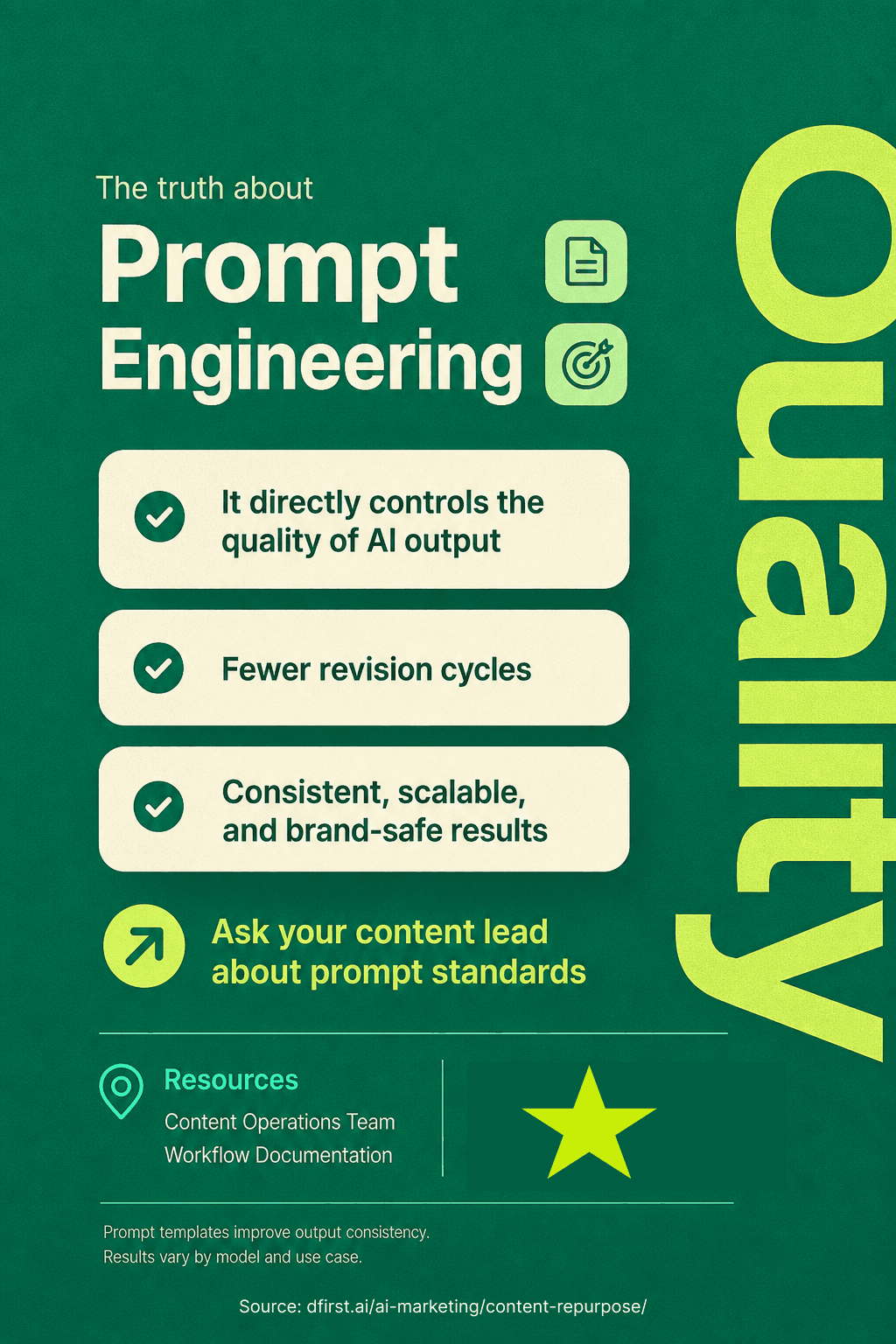
There are 5 reasons prompt engineering is the highest-leverage skill for content teams working with AI:
It directly controls output quality. A vague prompt produces vague content. A structured prompt that specifies persona, audience, format, length, tone, and constraints produces content that matches your editorial standard. The same model, with a better prompt, writes a better article.
It creates consistency across writers. Without shared prompt standards, every writer develops their own habits. Some work well; most don't. Standardising prompts into reusable templates means every writer starts from the same high baseline — and the gap between your best and weakest first drafts narrows.
It reduces review cycles. Every unnecessary edit your editor makes on AI-generated content is a cost a better prompt could have avoided. Teams that invest in prompt engineering report fewer revision rounds and shorter time-to-publish.
It protects brand voice at scale. As AI usage scales, brand voice is the first casualty. Encoding tone guidelines, vocabulary preferences, and audience context directly into prompt templates keeps your voice consistent when you're producing high volumes.
It enables meaningful oversight. Prompt engineering introduces structure to how your team uses AI, making it easier to audit outputs, trace quality issues to specific prompt problems, and improve over time.
How to structure prompts for content work
Good prompt structure follows a repeatable framework. One of the most practical is the PROMPT Canvas — a checklist for designing prompts that are consistent, testable, and easy to reuse:
P — Persona & Purpose. Who is the AI speaking as, and why is this piece being written? Specify a role ("You are a senior B2B content strategist writing for marketing leaders at mid-market SaaS companies") and a clear goal.
R — Research & Resources. What data, examples, or reference content should the AI draw on? If you have a product brief, a competitor article, or audience research, include it here. The AI can only use what you give it.
O — Output Format & Channels. What type of content are you creating, and where will it live? A LinkedIn post needs a different structure than a 1,500-word pillar page. Specify format, length, heading structure, and any formatting constraints.
M — Model & Mode. Which AI tool are you using? Some platforms offer system prompts, temperature settings, or special modes worth specifying. What works in Claude's system prompt context may need adjustment for ChatGPT's user-turn structure.
P — Prior Examples. Show the AI what good looks like. Providing one or two examples of content you want to emulate — a technique called few-shot prompting — is one of the most effective methods available.
T — Tests & Tone. What tone, voice, or style guidelines apply? What should the AI avoid? Positive directives ("write in a confident, direct tone with short paragraphs") work better than negative ones ("don't be too formal").
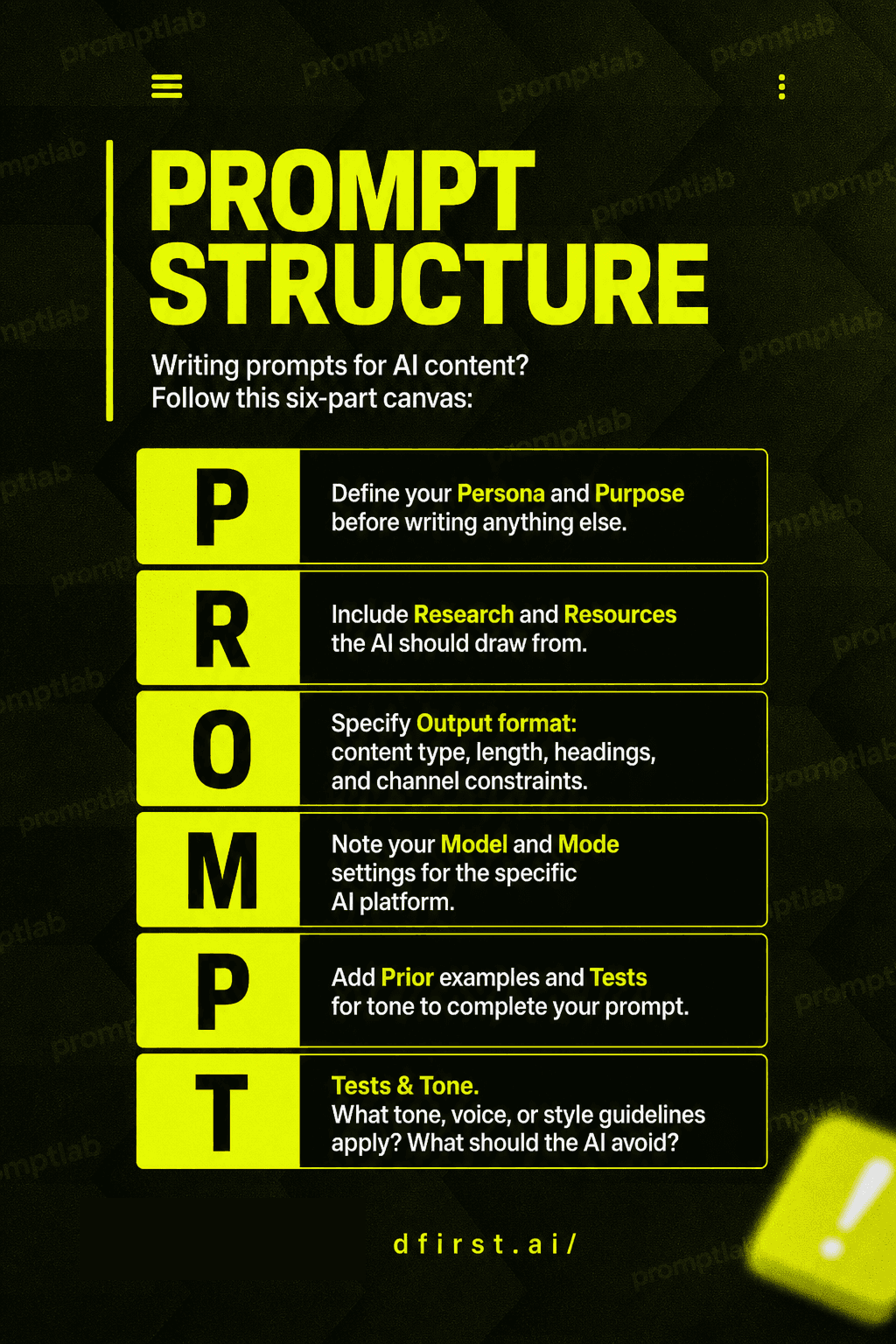
Using this canvas, your team can design prompts for every recurring content type — blog posts, product pages, email campaigns, social posts, case studies — and store them in a shared prompt library that everyone draws from.
5 core prompt engineering techniques for content teams
1. Few-shot prompting
Few-shot prompting means giving the AI one or more examples of the output you want before asking it to produce the content. It's one of the highest-impact techniques for content quality, and it's underused.
Instead of asking "write a product description for our analytics tool," you write: "Here are two product descriptions that match our tone and format: [Example 1] [Example 2]. Now write a product description for our analytics tool in the same style."
The practical application for content teams is an example bank: a collection of your best-performing content, broken down by type, that writers drop into their prompts as reference material. Keep it current. Swap out examples as your editorial standards evolve.
2. Persona-based prompting
Assign the AI a specific role before asking it to write. "You are an experienced B2B content strategist writing for CMOs at growth-stage SaaS companies" consistently outperforms "write a marketing article." The persona sets the model's interpretation of audience, tone, vocabulary, and depth.
Persona prompts work best when they're specific. "Act as an SEO editor reviewing this article for a SaaS blog targeting mid-market companies" produces much more useful feedback than "review this content."
One useful practice: maintain a library of reusable personas that map to your most common content types. A persona for technical documentation differs from one for thought leadership, which differs from one for product marketing copy.
3. Chain-of-thought prompting
For complex content tasks — research-heavy pieces, comparative analyses, strategic recommendations — chain-of-thought prompting asks the AI to show its reasoning step-by-step before arriving at the output. This improves accuracy and surfaces logic gaps before they end up in the draft.
If the condition is a complex, multi-argument piece, use: "First, outline the 3 main arguments this article should make and explain why each matters to this audience. Then write the article following that outline."
The step-by-step reasoning check before the draft often catches issues that would otherwise require a full editorial revision.
4. Template-based prompting
A prompt template is a structured format your team fills in for each new piece of content. A standard blog post template might look like this:
Role: You are a [role] writing for [target audience].
Goal: Write a [content type] about [topic].
Key points to cover: [bullet list]
Tone: [specific tone description — not "conversational" but "direct, uses second-person, short paragraphs, active voice"]
Format: [H1, H2s, approximate word count, formatting requirements]
Avoid: [off-brand language, topics to exclude, common mistakes]
Example of desired output: [paste a reference piece]
Templates reduce the cognitive load of prompting, give any writer a strong starting point, and — when stored centrally — become a self-updating knowledge base as the team tests and refines them.
5. AI as reviewer
Ask the AI to evaluate a draft against specific criteria rather than to generate new content. An evaluator prompt might say: "You are an editor for a B2B SaaS blog. Score the following introduction from 1–10 on clarity, specificity of benefits, and relevance to senior marketing leaders. Explain each score and suggest edits that would raise it by 2 points."
This turns AI into a structured feedback mechanism — useful for writers developing their prompting skills, and for editorial quality checks before content goes to a human editor.
How to scale prompt engineering across a content team
Building individual prompting skills is step one. The real leverage comes from scaling those skills team-wide.
Build a shared prompt library
A prompt library is a centralized collection of tested, reusable prompts organized by content type, channel, and use case. Think of it as a style guide for AI interactions. Every writer on your team starts from a prompt that's already been refined through testing — not one invented on the fly.
Your prompt library should include the prompt template, a brief note on when to use it, example outputs, and notes on what works and what to avoid. Version the prompts as you refine them, the same way you'd version any editorial asset.
Establish prompt standards
Define what makes a prompt "good" for your team's specific needs. That means setting standards for prompt structure (what components every prompt must include), tone encoding (how to translate your brand voice guidelines into prompt language), and output validation (how writers evaluate AI outputs before passing them to an editor).
These standards don't need to be long. A one-page prompt checklist in your team wiki creates more consistency than a 20-page guide nobody reads.
Train and upskill the team
Prompt engineering is a learnable skill. Most writers improve significantly with a few focused sessions. Run practical workshops around real content tasks your team does every day. Don't teach prompt engineering abstractly — show writers how to improve the specific prompts they're already using.
Pair workshops with a feedback loop: create a shared channel or document where writers post prompts that aren't working and get suggestions from colleagues. Collaborative iteration accelerates skill development faster than individual experimentation.
Monitor, measure, and iterate
Track the relationship between prompt quality and content performance. Which prompt templates produce first drafts that need the least editing? Which are associated with content that performs well in search or engagement? Using this data to iterate on your prompt library turns it from a static resource into a system that gets better over time.
5 common prompt engineering mistakes content teams make
1. Being too vague. "Write a blog post about email marketing" is a topic, not a prompt. Every effective prompt includes role, audience, format, and tone at minimum.
2. Using only negative directives. "Don't make it sound generic" doesn't tell the AI what to do. Replace negative instructions with positive ones: "Write in a direct, specific tone with concrete examples and data wherever available."
3. Skipping examples. Not providing reference content is the most common missed opportunity in content prompting. Even one example of the style you want improves output quality.
4. Not versioning prompts. Teams that improve their prompts but don't save the updated versions lose the gains. Treat your prompt library like a codebase — version it and note what changed.
5. Using one prompt for every content type. A long-form SEO guide needs a different prompt structure than a social post or an email subject line. Build type-specific templates rather than relying on one master prompt.
Frequently asked questions
What is the difference between prompt engineering and context engineering?
Prompt engineering is the practice of crafting individual inputs to get better outputs from an AI model. Context engineering goes further: it structures the entire information environment the AI operates in — including system prompts, memory, retrieved knowledge, and dynamic data — so the AI can produce high-quality outputs without being manually briefed each time. For most content teams, prompt engineering is the right starting point. Context engineering becomes relevant when you're building automated content workflows or AI agents that operate without per-task human input.
Do content writers need to learn to code to use prompt engineering?
No. Prompt engineering for content work is a writing and communication skill, not a technical one. The principles — specificity, structure, examples, persona, format — are editorial instincts applied to AI briefing. Writers with strong communication skills often pick it up faster than technical users.
How long should a content prompt be?
Long enough to cover role, audience, format, tone, and any specific requirements — typically 100–300 words for a detailed content task. Shorter prompts work for simple, well-defined tasks such as generating 5 headline options. Longer prompts with examples work best for full article drafts or complex research tasks. If a prompt exceeds 500 words, consider whether some of the context belongs in a system prompt rather than the user-turn.
What's the best way to get AI to match our brand voice?
Encode your brand voice directly in the prompt using specific descriptors, not vague adjectives. Instead of "conversational tone," write: "Direct, confident tone. No jargon. Uses second-person ('you'). Active voice. Short paragraphs, 2–3 sentences max." Pair this description with 2–3 examples of your best on-brand content. The examples do more work than the description.
How often should we update our prompt library?
Review your prompt library at least once per quarter. Update individual templates whenever you identify a better-performing version through testing, or when your editorial standards evolve. Assign ownership of the library to one person — usually a content strategist or editorial lead — to prevent it from going stale.
Wrapping up
The content teams getting the most value from AI aren't the ones with access to the best models. They're the ones with the best prompts — and the systems to share, refine, and improve them over time.
Prompt engineering for content teams is a skill, a process, and a genuine competitive edge. Start with the fundamentals: clear structure, specific personas, examples in every prompt. Build a shared library. Set standards. Train your team. Measure what works and update the prompts that don't.