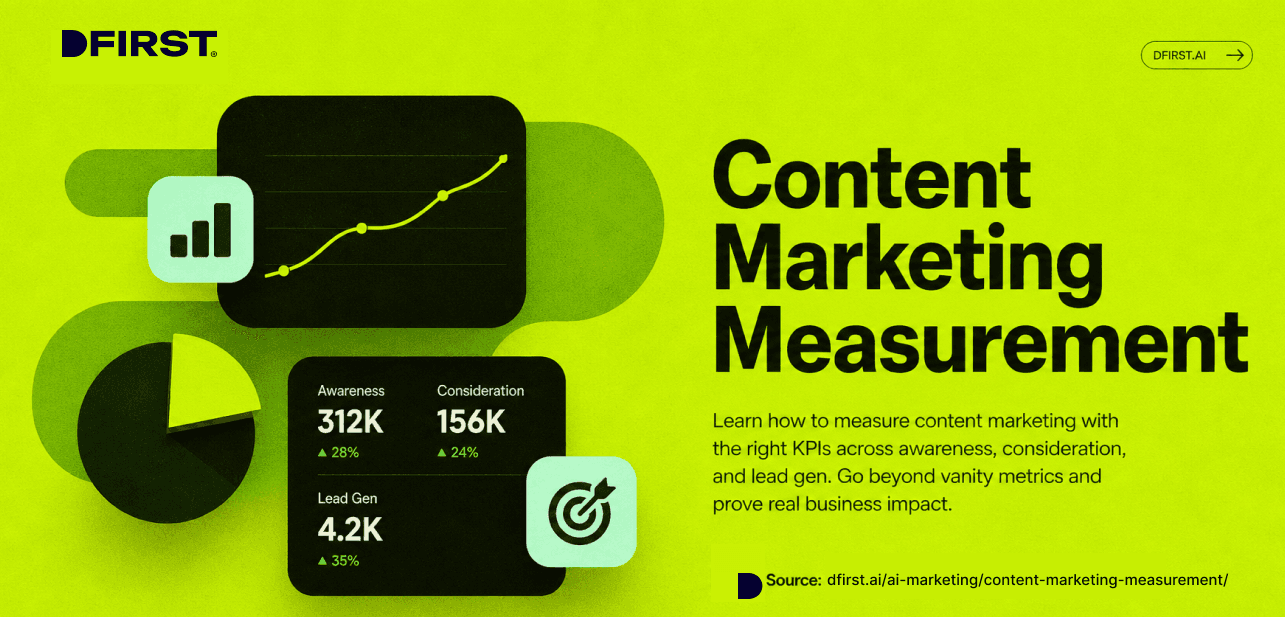
Content marketing measurement is the process of tracking, evaluating, and interpreting data from your content marketing efforts to determine how well they support your business goals.
It sits at the intersection of content marketing strategy, data analysis, and business performance, giving teams a structured way to understand what content is working, what is wasting budget, and where to focus next.
Content marketing measurement covers all content types — blog posts, email newsletters, downloadable assets, video, social media — and maps performance across 3 content funnel stages: awareness, consideration, and lead generation. Without a measurement framework in place, content marketing becomes guesswork.
This article is part of our content marketing series where we cover building your first AI-assisted content workflow through advanced use cases like topic clustering, audience simulation, and content repurposing at scale.
Why Content Marketing Measurement Matters
Most marketing and business leaders have never run content programs themselves. They don't have instincts for reading content data — which means if you can't show them clear business impact in plain English, your program is always one bad quarter away from a budget cut.
Here's why building a serious measurement practice matters:
You can isolate where the funnel breaks. When you measure at each stage — awareness, consideration, and lead gen — you know whether the problem is that nobody's finding you, or people are finding you but not considering you, or people are considering you but not converting. Without stage-level measurement, you're flying blind.
You can defend content investment. Traffic growth correlates with revenue growth. Pages-per-visit correlates with purchase intent. Lead volume and lead quality tie directly to sales pipeline. When you can show those connections, you stop fighting for budget and start requesting it.
You can catch manipulation early. When marketers are held accountable for a single KPI — say, LinkedIn follower count — they find ways to inflate it. Vanity metrics measured in isolation create incentives for bad behavior. A holistic measurement framework makes it much harder to game.
You can make smarter content decisions. Not all content serves the same purpose. Awareness content addressing reader problems performs very differently from consideration content explaining your product. Measuring each type against its actual job — not against a single universal metric — tells you what to double down on and what to cut.
The 3-Stage Content Marketing Funnel (And What to Measure at Each Stage)
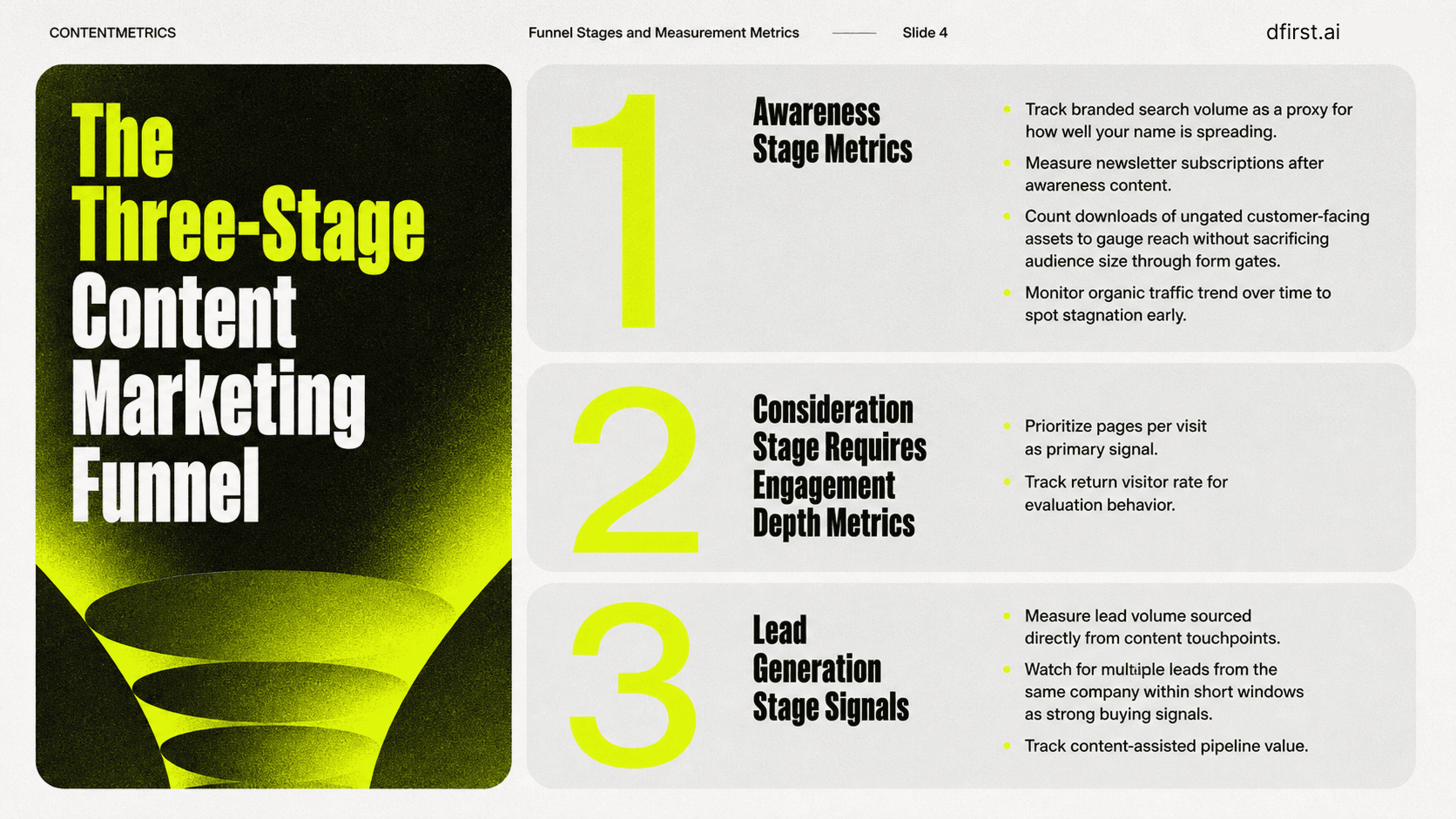
The most useful framework for content marketing measurement maps metrics to 3 funnel stages. Each stage has a distinct job, a distinct audience behavior, and distinct KPIs.
Stage 1: Awareness
Awareness content addresses the problems and issues your prospects face. It doesn't pitch your product — it demonstrates that you understand the reader's world. The goal is to get known.
There are 2 audiences you want to reach at this stage, and they behave very differently.
Fans are people who work in your industry — your peers. They spread your name, share your content, and build your reputation. A strong fan metric is blog or newsletter subscriptions. When someone subscribes after reading awareness content, it signals they found it valuable enough to want more. That's meaningful.
Customers are the people who actually buy. The problem is that customers tend to be lurkers — they read, evaluate quietly, and rarely engage on social media the way fans do. This means customer-facing awareness content often looks "underperforming" by conventional metrics, even when it's doing exactly its job.
To measure reach with customers, create downloadable content assets — white papers, buyer's guides, ebooks — that directly address customer concerns. Advertise them through outbound channels. Then measure downloads. Don't gate this content if you can avoid it; gating can cut your reach by 50% or more.
Key awareness metrics:
Branded search volume (a strong proxy for brand awareness, especially for B2B businesses that can't easily survey market awareness)
Newsletter/blog subscriptions
Downloads of ungated customer-facing assets
Organic traffic trend (should be growing over time; a flat or declining curve signals a problem)
Stage 2: Consideration
Consideration content is where you start talking about who you are, what you sell, and why prospects should buy from you. The audience is already aware — now they're evaluating options.
The best metric for consideration is pages per visit. Here's why: someone reading a single awareness article shows curiosity. Someone who reads a product page, then a case study, then checks your warranty or pricing section is actively comparing vendors. The more consideration pages an in-market prospect reads on average, the more likely it is they like what they see.
If prospects arrive at a product page and bounce in seconds, that's a signal that either your consideration content isn't doing its job, or the wrong audience is arriving.
Key consideration metrics:
Pages per visit
Time on page for product, case study, and comparison pages
Return visitor rate (people who come back are much further along in their evaluation)
Stage 3: Lead Generation
Lead generation is the ask. It pairs with both awareness and consideration content — sometimes a content download becomes a lead, sometimes a demo request follows a case study.
Lead gen metrics are more straightforward than the earlier stages. Track volume and quality. One particularly useful signal: leads from the same company. Anyone can fill out a contact form. But when 2 or more people from the same organization put themselves on your radar within a short window, that's a strong buying signal. They're not just curious — they're building a business case internally.
Key lead gen metrics:
Lead volume from content
Lead-to-customer conversion rate (track carefully — many other factors affect whether a lead converts, beyond how they were sourced)
Multi-contact signals (2+ leads from the same company)
Content-assisted pipeline (the revenue influenced by content across the funnel, not just direct last-click attribution)
Vanity Metrics: What They Actually Tell You
The term "vanity metrics" gets dismissed too easily. It implies these numbers are useless — they're not.
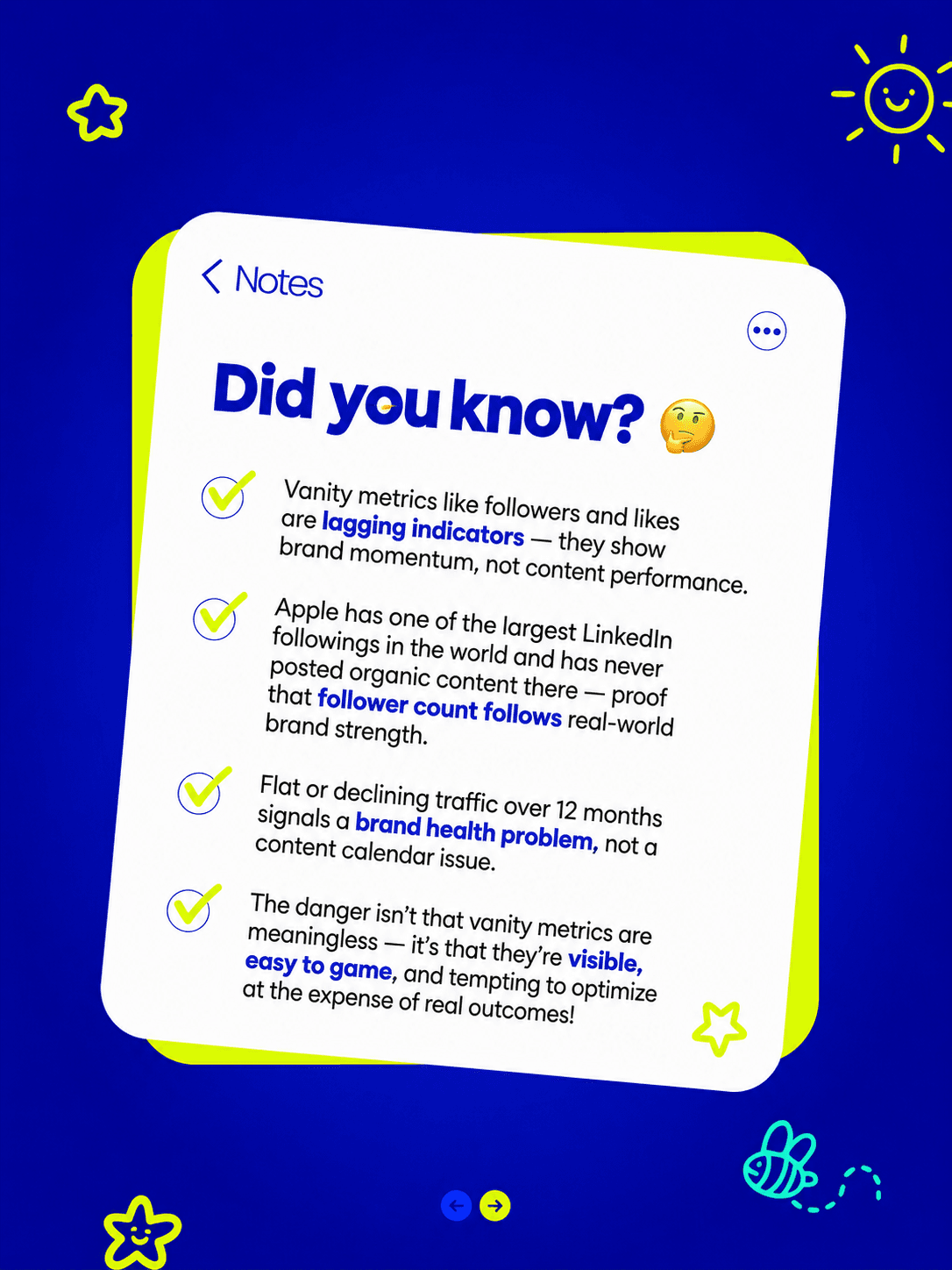
Web traffic, social followers, likes, and shares are lagging indicators of brand health, not leading ones. Apple has one of the largest LinkedIn brand followings in the world and has never posted a single piece of organic content there. Their follower count is a benefit of what they do in the real world, not a result of their LinkedIn strategy.
That's the right lens for vanity metrics: they tell you whether your brand has momentum in the market, not whether a specific content piece is performing.
If your vanity metrics are healthy, you have the wind at your back. You can publish content organically and expect it to get traction. If they're weak, you're fighting uphill, and paid amplification becomes a necessity rather than an option.
What vanity metrics actually signal:
Web traffic should grow over time. Algorithm updates can cause dips, but the overall trend should be upward. A flat or declining traffic curve over 12 months is a brand health warning sign.
Social media followers show whether anyone cares about your brand online. Zero followers means zero social proof. It doesn't need to be a huge number — it needs to be growing.
Likes and comments indicate whether your content is landing with real people. If your own employees aren't liking your posts, you have a content quality problem.
The real danger of vanity metrics isn't that they're meaningless — it's that they're visible and easy to optimize for. If someone's career depends on hitting a follower count, they'll buy followers. The solution isn't to ignore these metrics. It's to never make them the only thing someone is held accountable for.
How to Build a Balanced Basket of Content Marketing Metrics
The goal is to hold a mix of metrics that together give you a fair, manipulation-resistant picture of content performance. No single metric should dominate.
A well-balanced measurement framework has 4 properties:
1. It measures outside your own properties. Branded search volume, share of voice, and media mentions tell you how the world perceives you — not just how your website performs. If you only measure what happens on your own site, you miss the full picture.
2. It covers all 3 funnel stages. If you only measure lead volume, you can't tell whether a lead drop is caused by a top-of-funnel awareness problem or a middle-funnel consideration gap. Stage-level measurement makes it possible to diagnose the real issue.
3. It includes both leading and lagging indicators. Downloads, subscriptions, and pages per visit are leading signals — they tell you what's building. Revenue and customer lifetime value are lagging — they confirm what worked. You need both.
4. It's holistic enough to prevent gaming. When performance ratings depend on a range of metrics, no single number becomes worth manipulating. Any individual metric can be gamed by damaging others. A broader set makes that trade-off less attractive.
How to Present Content Marketing Data to Business Leaders
Most business leaders don't read content data — they don't have the background to find it intuitive. If you walk into a leadership meeting with a slide of metrics, their eyes will glaze over.
The right approach: lead with your recommendation in plain English. Tell them what you think should be done. If they ask what data supports it, then go deeper. Don't front-load the data backstory.
When you do need to go deeper, use the funnel as your framework. Show them visually where prospects are entering the funnel, where they're stalling, and where they're dropping off. "Not enough prospects are entering the funnel" is easy to grasp. "Our pages-per-visit metric is below benchmark" is not.
Three questions that help frame a leadership conversation:
Is enough traffic entering the top of our funnel? (Awareness gap)
Are in-market prospects engaging with our consideration content? (Consideration gap)
Are leads converting at a rate that makes content investment worthwhile? (Lead gen efficiency)
If you can answer those 3 questions clearly, with data behind each, you have everything you need to make a compelling business case for your content program.
The Role of AI in Content Marketing Measurement
AI is reshaping 2 areas of content measurement in particular.
Content repurposing and distribution. A single long-form piece of content can be repurposed into a video script, a newsletter edition, a LinkedIn post series, and a slide deck. AI tools can do this faster and at lower cost than manual rewrites. The caveat: repurposed content needs to be current. Statistics age quickly, cultural references go stale, and B2B content in particular can feel outdated within 12 months. Any repurposing should happen fast — ideally within a few months of the original asset — while the content is still fresh.
Visual content ideation. AI tools can generate a wide range of visual concepts from a simple prompt, giving creative teams more options to evaluate. The ideas AI generates aren't always better than what a human would have thought of — but they include options a human might never have considered. That additional creative surface area is genuinely useful.
What AI is not yet strong at: big-picture content performance analysis and strategic measurement decisions. Deciding which metrics matter most for your business, designing your measurement framework, and interpreting data in business context still requires human judgment.
Common Content Marketing Measurement Mistakes
Measuring everything instead of the right things. More metrics means more noise. A focused basket of 8 to 12 metrics across the 3 funnel stages is more useful than 40 metrics that nobody can interpret.
Confusing fan content with customer content. Content that gets high social engagement and subscriptions is often fan content — it appeals to industry peers, not buyers. If your measurement only tracks engagement, you'll produce more fan content and wonder why leads don't improve.
Treating every piece of content the same way. An awareness blog post and a product case study have completely different jobs. Measuring them against the same KPIs produces meaningless data.
Siloing content data from sales data. Sales teams often don't know what content exists or where to find it. Content that doesn't reach the sales team can't influence deals. Build a system — a content calendar shared with sales, a Slack channel, a regular update — so the people who need content know it exists.
Blaming measurement when the real problem is strategy. If you expect a single piece of content to drive awareness, consideration, and conversion simultaneously, no measurement system will help. The problem is the strategy, not the metrics.
FAQs: Content Marketing Measurement
Q: What is the most important content marketing metric?
A: There's no single most important metric — the right metric depends on your funnel stage and business goal. For brand awareness, branded search volume and organic traffic trend are strong indicators. For consideration, pages per visit is the most reliable signal. For lead generation, lead volume, quality, and multi-contact signals from the same company matter most.
Q: How do I prove content marketing ROI to my leadership team?
A: Lead with a plain-English recommendation, not raw data. Use the 3-stage funnel to show where prospects are entering, stalling, or dropping off. Frame the business case around revenue impact: traffic growth correlates with revenue growth, and content-assisted pipeline shows how content influences deals beyond last-click attribution.
Q: Are vanity metrics like social followers worth tracking?
A: Yes — with the right interpretation. Vanity metrics are lagging indicators of brand health, not leading indicators of revenue. Healthy vanity metrics mean you have wind at your back for organic content efforts. Weak vanity metrics signal you'll need paid amplification to get traction. The mistake is making them the sole accountability metric — that creates incentives to manipulate them.
Q: How do I measure content marketing awareness for a B2B brand?
A: Branded search volume is a reliable proxy, especially for companies that don't have sophisticated market awareness surveys. Newsletter subscriptions and downloads of ungated customer-facing assets (white papers, buyer's guides) are also strong signals. Avoid relying solely on social engagement data — B2B buyers tend to lurk rather than publicly engage.
Q: How do you avoid marketers gaming content KPIs?
A: Don't tie career outcomes to a single metric. Almost any online metric can be manipulated — often by damaging other metrics in the process. Performance reviews should reflect a holistic picture of content performance across multiple metrics and funnel stages, making gaming any single number a poor trade-off.
Q: How often should I review content marketing metrics?
A: For operational decisions (which content to promote, what to repurpose), review monthly. For strategic decisions (budget allocation, team structure, channel prioritization), review quarterly. Branded search volume and traffic trend are best interpreted over 6 to 12-month windows — short-term fluctuations are noise.
Final Thought
Content marketing measurement works when it's tied to business outcomes, structured around the full funnel, and honest about what different metrics can and can't tell you. Vanity metrics aren't the enemy — misusing them is. The right basket of metrics, presented clearly to business leaders, turns content from a line item that's hard to justify into a program that earns its budget every quarter.
Start by picking one metric at each funnel stage. Measure consistently. Then build from there.