When most people hear the term AI marketing campaigns, they picture flashy brand stunts, AI-generated videos, or chatbots replying to customers at 2 a.m.
But that’s not really a campaign.
That’s just a tool being used inside one.
Here’s the misunderstanding:
Using AI once - to write an ad, design an image, or optimize an email subject line - does not automatically mean you’re running an AI marketing campaign.
It simply means you used AI.
A true AI marketing campaign is different.
It’s not about one tool.
It’s not about automation for the sake of automation.
And it’s definitely not about replacing marketers.
It’s about building a coordinated marketing system where AI supports multiple stages of the campaign - from research and planning to content creation, targeting, personalization, and optimization.
That’s the shift.
Most content online shows you examples.
Some articles highlight brands using AI creatively.
Others list tools you can try.
But very few explain how to actually structure and run an AI-powered campaign from start to finish - especially if you’re a beginner.
That’s what this guide will do.
In this complete guide, you’ll learn:
What AI marketing campaigns really are
How they differ from traditional campaigns
The core components that make them work
A step-by-step system to build your first one
Common mistakes to avoid
And how to think about AI strategically - not just tactically
By the end, you won’t just know what AI marketing campaigns look like.
You’ll understand how to build one.
Try DFIRST to Create Marketing Content Faster
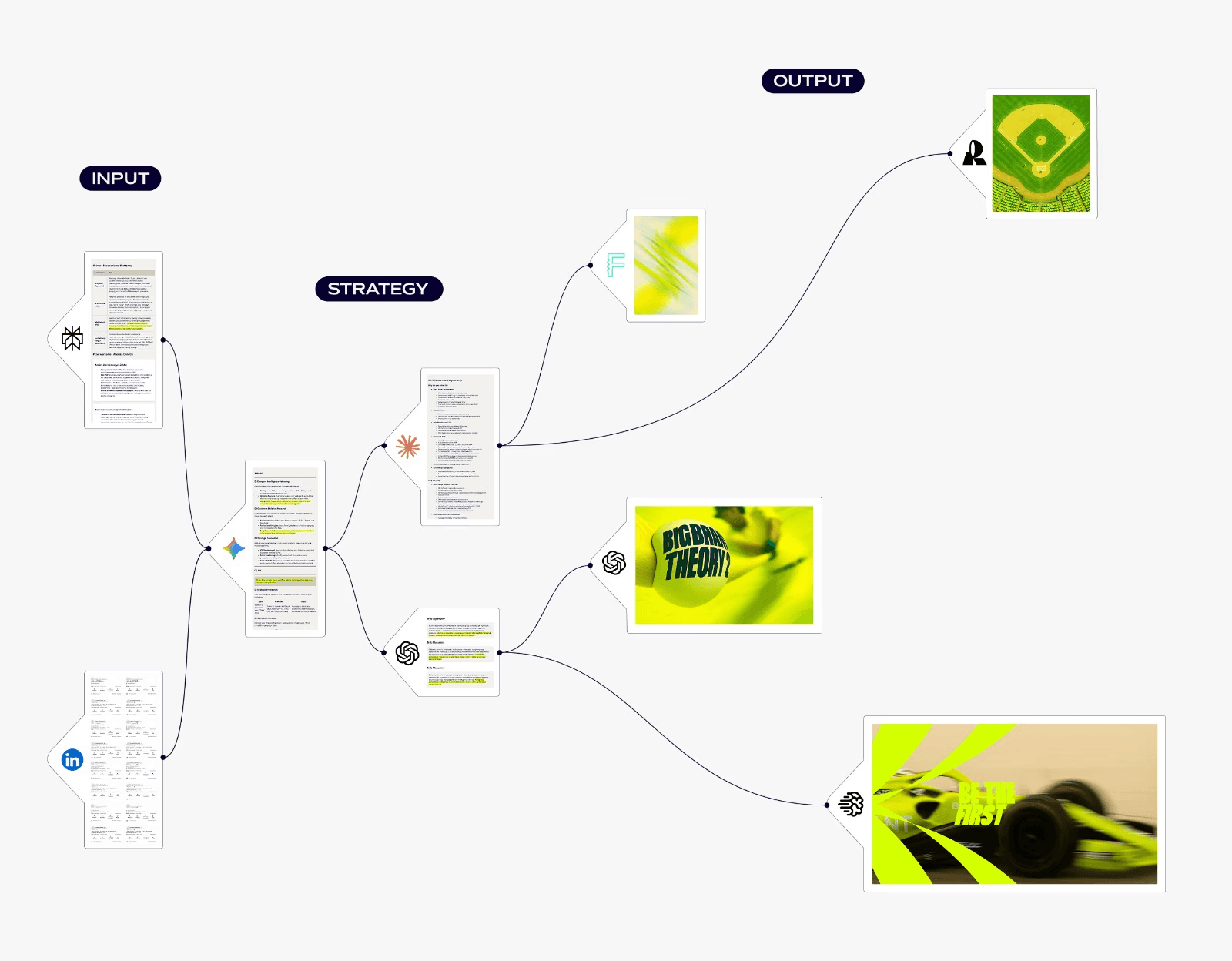
DFIRST is a platform where you connect AI tools on a canvas to create marketing campaigns faster. Instead of juggling multiple apps and manual work, you build workflows that handle everything from research to final ads.
→ The Canvas: Build campaigns by connecting simple nodes on a canvas. Draw lines to link research, writing, and image steps. The data moves automatically, so you don't copy-paste.
→ Research Built In: The platform checks multiple sources—competitor sites, social media, papers. Set up a research node to pull market data right into your content flow.
→ Creating Marketing Assets: Text nodes write ads and posts. Image nodes use tools like DALL-E to make visuals. The system keeps track, so your images always match your writing.
→ 50+ AI Model: You can use models like GPT-4, Claude, and Gemini. The platform chooses the best one for each task, or you can pick yourself. Pro users get faster, newer models.
→ Your Data Room: Upload your brand guides and old files. The AI learns from these documents to match your company's voice. Your private data is never used to train the models.
→ Working Space: Every campaign gets a dedicated whiteboard. Start with a template or ask the AI to build a workflow for you. Save the best ones to use again later.
For agencies doing client work, this matters. You can cut production time from weeks to hours while keeping everything consistent. Pricing: Free 80 tokens daily. Starter: $39/month. Pro: $199/month.
Generate your first flow for free - no credit card required.
What Are AI Marketing Campaigns?
Let’s define this clearly before we go any further.
An AI marketing campaign is a coordinated marketing effort where artificial intelligence supports strategy, creation, targeting, personalization, or optimization across multiple stages of the campaign.
Notice the key phrase: multiple stages.
If AI is used in just one isolated task, that’s AI-assisted marketing.
If AI influences how the campaign is planned, executed, and improved - that’s an AI marketing campaign.
To make this simple, think of AI marketing campaigns in three levels.
Level 1: AI-Assisted Campaigns
This is where most beginners start.
AI helps create content, but the campaign structure remains traditional.
Examples:
Using AI to write ad copy
Generating social media captions
Creating images with an AI design tool
Drafting email sequences
The strategy, targeting, and performance decisions are still mostly manual.
AI is acting like a smart assistant.
This level saves time, but it doesn’t fundamentally change how campaigns operate.
Level 2: AI-Optimized Campaigns
At this stage, AI doesn’t just create - it improves.
AI is used to:
Analyze audience data
Predict which segments are more likely to convert
Adjust ad bids automatically
Personalize email timing
Optimize headlines based on performance
The campaign still has a human-defined strategy, but AI actively improves outcomes in real time.
This is where performance marketers start seeing serious efficiency gains.
Level 3: AI-Native Campaigns
This is the most advanced level.
Here, AI is integrated across the entire campaign lifecycle:
AI conducts research
AI helps shape messaging strategy
AI generates creative variations
AI personalizes experiences per user
AI distributes content dynamically
AI continuously optimizes performance
Humans guide the direction, brand voice, and decision-making - but AI is embedded into the system itself.
This is no longer “using AI tools.”
This is building a campaign where AI is part of the infrastructure.
Understanding these three levels creates clarity.
You don’t need to jump straight to Level 3.
Most beginners start at Level 1 and gradually move upward.
But once you understand the levels, you can intentionally design your campaign - instead of randomly adding AI tools and hoping for better results.
Now that we’ve defined what AI marketing campaigns actually are, let’s look at how they differ from traditional marketing campaigns - and why that difference matters.
How AI Changes the Traditional Campaign Model
To understand the impact of AI marketing campaigns, we first need to look at how traditional campaigns work.
For years, the flow has looked like this:
Research → Strategy → Create → Launch → Analyze → Optimize
It’s linear.
You research the market.
You build a strategy.
You create assets.
You launch the campaign.
Then you wait.
After enough data comes in, you analyze and optimize.
The process works, but it’s slow, manual, and often reactive.
Now compare that to an AI-powered campaign flow:
AI Research → AI-Assisted Strategy → AI Content Production → Automated Launch → Real-Time Optimization → Iteration Loop
The structure changes from linear to dynamic.
Here’s what shifts.
1. Speed
Traditional research can take weeks.
With AI:
Market insights can be gathered in minutes.
Competitor messaging can be analyzed instantly.
Creative variations can be generated rapidly.
Instead of waiting to move to the next stage, teams move faster across all stages.
Campaign production time shrinks dramatically.
2. Scale
In a traditional model, creating 5 ad variations takes effort.
Creating 50? That’s expensive.
With AI content production, scaling creative assets becomes far easier:
Multiple headlines
Personalized emails
Dynamic ad visuals
Localized messaging for different regions
AI doesn’t just speed things up - it multiplies output without multiplying effort at the same rate.
3. Feedback Loops
Traditional campaigns often optimize after results come in.
AI-powered campaigns optimize during the campaign.
Algorithms analyze:
Click-through rates
Conversion patterns
Engagement signals
Audience behavior
Instead of a delayed “analyze → adjust” cycle, you get a continuous improvement loop.
The campaign learns while it runs.
4. Personalization
Traditional campaigns target segments.
AI campaigns can target individuals.
Using behavior data and predictive insights, AI can:
Change messaging dynamically
Recommend products based on browsing behavior
Adjust timing of emails per user
Serve different creatives to different micro-segments
This shifts campaigns from broad messaging to adaptive experiences.
The biggest difference isn’t just automation.
It’s architecture.
Traditional campaigns are built like projects.
AI marketing campaigns are built like systems.
And once you start thinking in systems instead of isolated tasks, everything changes.
Now that you understand how the model evolves, let’s break down the core components that make AI marketing campaigns actually work.
Core Components of AI Marketing Campaigns
Now that you understand how AI changes the campaign model, let’s break it down into something practical.
Every AI marketing campaign - whether simple or advanced - is built on six core building blocks.
If you understand these six, you can design your own campaign from scratch.
1. AI-Powered Market Research
What it means
AI helps you understand your market faster - trends, competitors, keywords, customer behavior, and demand patterns - without spending weeks on manual research.
Instead of guessing what people want, AI analyzes data patterns and gives insights in minutes.
Beginner example
You want to promote a skincare product.
Instead of manually reading reviews for hours, you use:
AI to analyze Amazon reviews
AI to summarize customer complaints
AI to identify trending skincare concerns
Now you know what angle to use in your campaign.
Tools commonly used
ChatGPT
Google Trends
SEMrush
Ahrefs
Why it matters
You reduce guesswork
You move faster
You align your campaign with real demand
AI marketing campaigns begin with intelligence - not assumptions.
2. AI Audience Segmentation
What it means
AI groups your audience based on behavior, interests, purchase intent, and engagement patterns.
Instead of broad targeting (“18–35 years old”), AI finds micro-segments like:
People who abandoned cart twice
Users who watch 75% of your videos
Visitors who compare pricing pages
Beginner example
You run Facebook ads.
Instead of targeting “fitness lovers,” AI helps create:
High-intent buyers
Warm visitors
Repeat customers
Cold lookalike audiences
Tools commonly used
Meta Ads Manager
Google Ads
HubSpot
Klaviyo
Why it matters
Better targeting
Lower ad costs
Higher conversion rates
AI marketing campaigns win because they talk to the right people - not everyone.
3. AI Content Creation (Text, Image, Video)
What it means
AI assists in producing campaign assets - ad copy, emails, landing pages, visuals, short-form videos, scripts.
This is where most beginners stop.
But content generation alone is not a full AI marketing campaign - it’s just one layer.
Beginner example
You need:
5 ad variations
3 email sequences
2 landing page headlines
AI generates drafts in minutes, and you refine them.
Tools commonly used
ChatGPT
Jasper
Canva
Midjourney
Synthesia
Why it matters
Rapid experimentation
More creative testing
Lower production cost
AI marketing campaigns create more variations and variation increases performance.
4. AI Personalization
What it means
AI customizes the experience for each user - dynamically changing:
Email subject lines
Website content
Product recommendations
Ad messaging
Instead of one message for everyone, AI creates contextual experiences.
Beginner example
A returning visitor sees:
“Welcome back, here’s 10% off.”
A new visitor sees:
“First time here? Start with our bestseller.”
Same campaign. Different experiences.
Tools commonly used
Dynamic Yield
Optimizely
Klaviyo
Why it matters
Higher engagement
Increased retention
Stronger customer relationships
AI marketing campaigns feel personal - even at scale.
5. AI Media Buying & Distribution
What it means
AI automatically manages where, when, and how your ads are shown - optimizing bids, placements, and budgets in real time.
This removes manual ad tweaking.
Beginner example
You launch ads on:
Facebook
Instagram
Google
Instead of manually adjusting budgets daily, AI shifts spending toward the best-performing audiences.
Tools commonly used
Meta Ads Manager
Google Ads
TikTok Ads Manager
Why it matters
Better ROI
Smarter budget allocation
Less manual work
AI marketing campaigns are not static - they adapt continuously.
6. AI Performance Optimization
What it means
AI tracks performance data in real time and recommends (or automatically makes) improvements.
It identifies:
Which headline converts best
Which audience performs poorly
Which time slot drives sales
And adjust accordingly.
Beginner example
You launch 5 ad creatives.
AI identifies:
Creative #3 has highest CTR
Creative #5 has best conversion rate
It reallocates the budget automatically.
Tools commonly used
Google Analytics
Meta Ads Manager
HubSpot
Why it matters
Faster learning cycles
Lower wasted spend
Continuous improvement
AI marketing campaigns improve while running - not after they fail.
Why These 6 Components Matter
Most beginners think AI marketing campaigns = AI writing content.
That’s incomplete.
A real AI marketing campaign connects:
Research → Segmentation → Creation → Personalization → Distribution → Optimization
When all six work together, you move from “using AI tools” to running true AI marketing campaigns.
Step-by-Step: How to Build Your First AI Marketing Campaign
Now that you understand the components, let’s build your first AI marketing campaign from scratch.
No complexity.
No jargon.
Just a practical system you can follow.
Step 1: Define Your Campaign Goal
Before using any AI tool, define one clear objective.
Ask yourself:
Do I want leads?
Do I want sales?
Do I want brand awareness?
Do I want app downloads?
Do I want webinar registrations?
AI marketing campaigns only work well when the goal is clear.
If your goal is unclear, AI will optimize for the wrong outcome.
Beginner Tip:
Choose one primary KPI:
Leads → Cost per Lead
Sales → Return on Ad Spend (ROAS)
Awareness → Reach or Engagement
Clarity first. AI second.
Step 2: Use AI for Market & Competitor Research
Now you gather intelligence.
Instead of manually researching competitors for days, use AI to:
Analyze competitor ads
Summarize reviews
Identify gaps in messaging
Extract common customer pain points
Spot trending keywords
For example:
Use ChatGPT to:
Summarize competitor landing pages
Generate positioning angles
Identify emotional triggers
Use SEMrush or Ahrefs to:
Identify high-intent keywords
Analyze traffic sources
Understand competitor ad strategies
What AI does here:
It compresses weeks of research into hours.
This makes your AI marketing campaign data-backed from day one.
Step 3: Build Audience Segments Using AI Insights
Now that you understand the market, you define who to target.
Instead of broad targeting, create layered segments:
Cold audience (new prospects)
Warm audience (engaged but not converted)
Hot audience (ready to buy)
Existing customers (upsell)
Use platforms like:
Meta Ads Manager
Google Ads
Their AI systems analyze:
Click behavior
Engagement patterns
Purchase history
Lookalike modeling
Your job is not to guess.
Your job is to feed AI good inputs.
Better inputs → better outputs.
Step 4: Create Campaign Assets with AI
Now comes production.
Your AI marketing campaign needs assets:
Ad copy
Headlines
Landing pages
Email sequences
Creatives (images/videos)
Use AI to generate multiple variations.
For example:
5 ad hooks
3 emotional angles
2 landing page structures
3 email subject line versions
Tools you can use:
ChatGPT for copy
Canva for creatives
Jasper for marketing copy
Important:
Don’t publish raw AI output.
Refine.
Edit.
Add human context.
AI accelerates creation. You control quality.
Step 5: Automate Distribution
Now you connect everything.
AI marketing campaigns work best when distribution is automated.
This includes:
Programmatic ad delivery
Email automation sequences
Retargeting flows
Chatbot responses
For example:
Use Meta Ads Manager to automate budget allocation.
Use Klaviyo for AI-driven email flows.
Use HubSpot for automated lead nurturing.
Automation ensures your campaign works 24/7.
No manual micromanagement.
Step 6: Launch & Let AI Optimize
This is where AI becomes powerful.
Once your campaign is live:
AI tests different creatives
AI shifts budget to high performers
AI adjusts bidding strategies
AI optimizes targeting
Platforms like:
Google Ads
Meta Ads Manager
Continuously learn from performance data.
Unlike traditional campaigns, AI marketing campaigns evolve in real time.
Step 7: Measure & Improve
Finally, you measure performance.
Track:
Cost per acquisition
Conversion rate
Click-through rate
Revenue per user
Customer lifetime value
Use:
Google Analytics
Your CRM dashboards
Ad platform reporting tools
Here’s the key difference:
Traditional marketing → Analyze after the campaign ends.
AI marketing campaigns → Improve while running.
You’re not launching once.
You’re building a feedback loop.
The Real Power of AI Marketing Campaigns
When you follow these 7 steps:
You move from “experimenting with AI tools”
To run a structured, scalable AI marketing campaign.
That’s the difference between:
Playing with AI and
Building a performance system with AI.
Tools Used in AI Marketing Campaigns
When people search for AI marketing campaigns, they often expect a long list of tools.
But tools only make sense when you understand where they fit in the campaign.
Instead of listing random platforms, let’s organize them based on campaign stages.
This gives beginners clarity - and prevents tool overload.
1. Research AI Tools
These tools help you understand your market before launching a campaign.
They assist with:
Keyword research
Competitor analysis
Audience insights
Trend tracking
Search intent discovery
Commonly used tools:
ChatGPT – Market summaries, positioning ideas, customer pain point extraction
SEMrush – Keyword research and competitor traffic insights
Ahrefs – Backlink and search analysis
Google Trends – Identifying trending topics
Why this matters:
Strong AI marketing campaigns begin with data, not assumptions.
2. Writing AI Tools
These tools generate and refine marketing copy.
They’re commonly used for:
Ad copy
Email sequences
Landing page drafts
Product descriptions
Blog posts
Commonly used tools:
ChatGPT – General content creation
Jasper – Marketing-focused copy
Copy.ai – Short-form promotional content
Why this matters:
AI reduces production time while allowing you to test multiple variations quickly.
3. Image & Video AI Tools
Visual content is a core part of AI marketing campaigns.
These tools assist with:
Ad creatives
Social media visuals
Thumbnails
Short-form videos
Product mockups
Commonly used tools:
Canva – AI-assisted design
DALL-E – AI image generation
Midjourney – Stylized image creation
Runway – AI-powered video editing
Why this matters:
Campaign speed increases when visuals and copy are produced simultaneously.
4. Analytics AI Tools
These tools analyze campaign performance and surface insights.
They assist with:
Conversion tracking
Attribution modeling
Behavior analysis
Performance forecasting
Commonly used tools:
Google Analytics – Traffic and conversion tracking
HubSpot – Lead tracking and reporting
Tableau – Performance visualization
Why this matters:
AI marketing campaigns rely on fast feedback loops, and analytics tools provide the signals for optimization.
5. Automation Tools
Automation tools ensure your campaign runs consistently without manual intervention.
They manage:
Email workflows
Lead nurturing sequences
Ad budget adjustments
CRM updates
Retargeting flows
Commonly used tools:
Klaviyo – AI-driven email flows
Zapier – Workflow integration
ActiveCampaign – Automated customer journeys
Meta Ads Manager – Automated ad delivery
Why this matters:
AI marketing campaigns are not just creative - they are operational systems.
Important Note
Tools alone do not create AI marketing campaigns.
Strategy connects them.
Without structure, tools create chaos.
With structure, they create scalable campaigns.